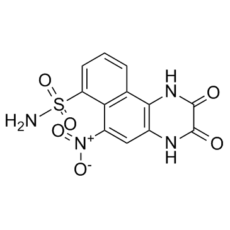
| CAS NO: | 118876-58-7 |
| 规格: | ≥98% |
| 包装 | 价格(元) |
| 5mg | 电议 |
| 10mg | 电议 |
| 25mg | 电议 |
| 50mg | 电议 |
| 100mg | 电议 |
| 250mg | 电议 |
| 500mg | 电议 |
| Molecular Weight (MW) | 336.28 |
|---|---|
| Formula | C12H8N4O6S |
| CAS No. | 118876-58-7 |
| Storage | -20℃ for 3 years in powder form |
| -80℃ for 2 years in solvent | |
| Solubility (In vitro) | DMSO: ≥ 75 mg/mL |
| Water: <1 mg/mL | |
| Ethanol: <1 mg/mL | |
| Chemical Name | 2,3-Dioxo-6-nitro-1,2,3,4-tetrahydrobenzo[f]quinoxaline -7-sulfonamide |
| Synonyms | FG9202; FG-9202; FG 9202 |
| In Vitro | In vitro activity: NBQX (also known as FG9202) is a novel and potent antagonist of aminomethylphosphonic acid receptor (AMPAR) with IC50 of 0.7 ± 0.1 μM. It has the potential to treat seizure. Brief NBQX administration during the 48 h postseizure in P10 Long-Evans rats suppresses transient mTOR pathway activation and attenuates spontaneous recurrent seizures, social preference deficits, and mossy fiber sprouting observed in vehicle-treated adult rats after early life seizures. These results suggest that acute AMPAR antagonist treatment during the latent period immediately following neonatal HS can modify seizure-induced activation of mTOR, reduce the frequency of later-life seizures, and protect against CA3 mossy fiber sprouting and autistic-like social deficits. Kinase Assay: NBQX (also known as FG9202) is a novel and potent antagonist of aminomethylphosphonic acid receptor (AMPAR) with IC50 of 0.7 ± 0.1 μM. Cell Assay: |
|---|---|
| In Vivo | Brief NBQX administration during the 48 h postseizure in P10 Long-Evans rats suppresses transient mTOR pathway activation and attenuates spontaneous recurrent seizures, social preference deficits, and mossy fiber sprouting observed in vehicle-treated adult rats after early life seizures. Postseizure NBQX treatment significantly attenuated seizure-induced increases in p-p70S6K in the hippocampus (p < 0.01) and cortex (p < 0.001). Although spontaneous recurrent seizures increased in adulthood in HS + V rats compared to controls (3.22 ± 1 seizures/h; p = 0.03), NBQX significantly attenuated later-life seizures (0.14 ± 0.1 seizures/h; p = 0.046). HS + N rats showed less aberrant mossy fiber sprouting (115 ± 8.0%) than vehicle-treated post-HS rats (174 ± 10%, p = 0.004), compared to controls (normalized to 100%). Finally, NBQX treatment prevented alterations in later-life social behavior; post-HS rats showed significantly decreased preference for a novel over a familiar rat (71.0 ± 12 s) compared to controls (99.0 ± 15.6 s; p < 0.01), whereas HS + N rats showed social novelty preference similar to controls (114.3 ± 14.1 s). |
| Animal model | P10 Long-Evans rats |
| Formulation & Dosage | |
| References | Epilepsia. 2013 Nov;54(11):1922-32. |
 m.cnreagent.com