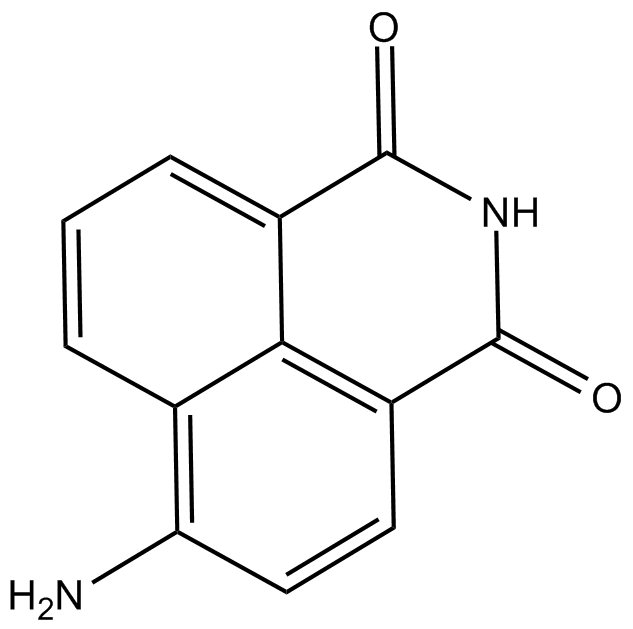
| CAS NO: | 1742-95-6 |
| 包装 | 价格(元) |
| 50mg | 电议 |
| 100mg | 电议 |
| 250mg | 电议 |
| Physical Appearance | A crystalline solid |
| Storage | Store at -20°C |
| M.Wt | 212.2 |
| Cas No. | 1742-95-6 |
| Formula | C12H8N2O2 |
| Synonyms | 4-Aminonaphthalimide,4-ANI |
| Solubility | ≤1mg/ml in DMSO;0.3mg/ml in dimethyl formamide |
| Chemical Name | 6-amino-1H-benz[de]isoquinoline-1,3(2H)-dione |
| Canonical SMILES | NC1=C2C(C3=CC=C2)=C(C=C1)C(NC3=O)=O |
| 运输条件 | 蓝冰运输或根据您的需求运输。 |
| 一般建议 | 为了使其更好的溶解,请用37℃加热试管并在超声波水浴中震动片刻。不同厂家不同批次产品溶解度各有差异,仅做参考。若实验所需浓度过大至产品溶解极限,请添加助溶剂助溶或自行调整浓度。溶液形式一般不宜长期储存,请尽快用完。 |
4-amino-1,8-Naphthalimide is a novel inhibitor of PARP with IC50 value of 180 nM [1][3].
The poly(ADP-ribose) polymerases (PARPs) is a nuclear enzyme that catalyzes a transfer of the ADP-ribose moiety of NAD+ to acceptor protein with a concomitant release of nicotinamide. PARPs play important roles in DNA repair, cell differentiation, control of cell cycle, transformation, transcription, and alteration of chromatin architecture [2][3][4].
4-amino-1,8-Naphthalimide (4-ANI) is a novel PARP inhibitor and a radiation sensitizer. In exponentially growing hamster lung fibroblasts (V79), rat prostate carcinoma (R3327-AT1) and human prostate carcinoma (DU145) cells, 4-ANI significantly potentiated the cytotoxicity of gamma-irradiation in a dose dependent way and is not cytotoxic in the absence of radiation. 4-ANI was used to study the role of PARP activity in a variety of cell systems [1][3].
References:
[1]. Schlicker A, Peschke P, Bürkle A, et al. 4-Amino-1,8-naphthalimide: a novel inhibitor of poly(ADP-ribose) polymerase and radiation sensitizer. Int J Radiat Biol. 1999 Jan;75(1):91-100.
[2]. Davar D1, Beumer JH, Hamieh L, et al. Role of PARP inhibitors in cancer biology and therapy. Curr Med Chem. 2012;19(23):3907-21.
[3]. Banasik M, Komura H, Shimoyama M,et al. Specific inhibitors of poly(ADP-ribose) synthetase and mono(ADP-ribosyl)transferase. J Biol Chem. 1992 Jan 25;267(3):1569-75.
[4]. Issaeva N, Thomas HD, Djureinovic T, et al. 6-thioguanine selectively kills BRCA2-defective tumors and overcomes PARP inhibitor resistance. Cancer Res. 2010 Aug 1;70(15):6268-76.
 m.cnreagent.com