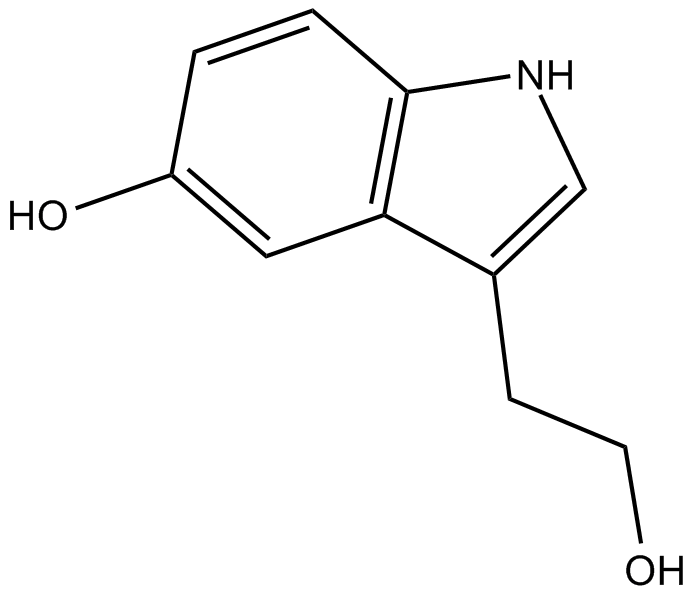
| CAS NO: | 154-02-9 |
| 包装 | 价格(元) |
| 10mg | 电议 |
| 25mg | 电议 |
| 100mg | 电议 |
| Physical Appearance | A crystalline solid |
| Storage | Store at -20°C |
| M.Wt | 177.2 |
| Cas No. | 154-02-9 |
| Formula | C10H11NO2 |
| Synonyms | NSC 84416 |
| Solubility | ≤30mg/ml in ethanol;30mg/ml in DMSO;30mg/ml in dimethyl formamide |
| Chemical Name | 5-hydroxy-1H-indole-3-ethanol |
| Canonical SMILES | OCCC1=CNC2=C1C=C(O)C=C2 |
| 运输条件 | 蓝冰运输或根据您的需求运输。 |
| 一般建议 | 为了使其更好的溶解,请用37℃加热试管并在超声波水浴中震动片刻。不同厂家不同批次产品溶解度各有差异,仅做参考。若实验所需浓度过大至产品溶解极限,请添加助溶剂助溶或自行调整浓度。溶液形式一般不宜长期储存,请尽快用完。 |
5-hydroxy Tryptophol is a metabolite of tryptophan.
Tryptophan (encoded by the codon UGG) is an α-amino acid that is used in the biosynthesis of proteins. Tryptophan has an α-amino group, an α-carboxylic acid group, and a side chain indole, demonstrating it as a non-polar, aromatic amino acid. Tryptophan is critical in humans, but the body cannot synthesize it and therefore tryptophan must be obtained from the diet. Tryptophan is also found to be a precursor to the neurotransmitters serotonin and melatonin.
In vitro: In previous studies, 5-hydroxy tryptophol was identified as a metabolite of tryptophan that was formed by the alcohol dehydrogenase-catalyzed reduction of the serotonin intermediate, 5-hydroxyindoleacetaldehyde. Moreover, depending on the tissue NAD/NADH ratio, the acetaldehyde intermediate could also be oxidized by aldehyde dehydrogenase to form 5-hydroxyindoleacetic acid. Therefore, the ratio of 5-hydroxy tryptophol to 5-hydroxyindoleacetic acid could be used as a biomarker for recent alcohol consumption [1,2].
In vivo: Up to now, there is no animal in vivo data reported.
Clinical trial: So far, no clinical study has been conducted.
References:
[1] Yokoyama, M. T. and Carlson, J.R. Dissimilation of tryptophan and related indolic compounds by ruminal microorganisms in vitro. Appl.Microbiol. 27(3), 540-548 (1974).
[2] Beck, O. ,Stephanson, N.,Btthcer, M., et al. Biomarkers to disclose recent intake of alcohol: Potential of 5-hydroxytryptophol glucuronide testing using new direct UPLC-tandem MS and ELISA methods. Alcohol & Alcoholism 42(4), 321-325 (2007).
 m.cnreagent.com