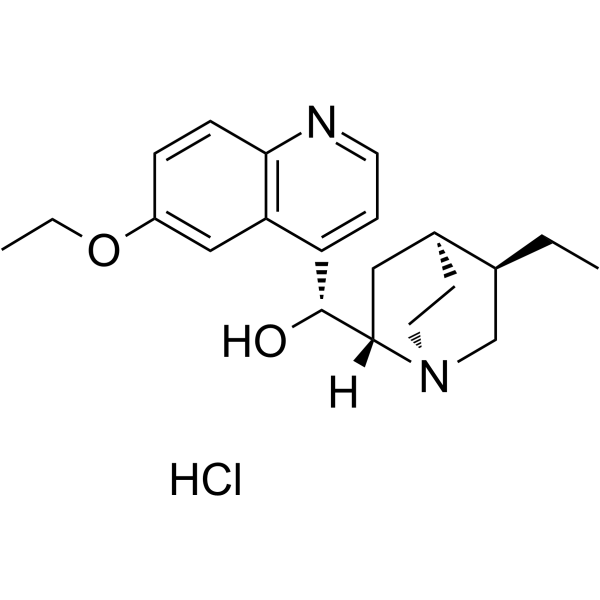
| CAS NO: | 3413-58-9 |
| 包装 | 价格(元) |
| 25mg | 电议 |
| 50mg | 电议 |
| 100mg | 电议 |
| Cas No. | 3413-58-9 |
| 别名 | 乙基氢化铜蛋白,Optochin hydrochloride |
| 分子式 | C21H29ClN2O2 |
| 分子量 | 376.92 |
| 溶解度 | DMSO : 125 mg/mL (331.64 mM; Need ultrasonic) |
| 储存条件 | 4°C, protect from light |
| General tips | For obtaining a higher solubility , please warm the tube at 37 ℃ and shake it in the ultrasonic bath for a while. |
| Shipping Condition | Evaluation sample solution : ship with blue ice All other available size: ship with RT , or blue ice upon request |
| 产品描述 | Ethylhydrocupreine hydrochloride (Optochin hydrochloride) is a quinine derivate with antimicrobial activity against S. pneumoniae. Ethylhydrocupreine hydrochloride also possesses antimalarial activity against Plasmodium falciparum, with an IC50 of 25.75 nM. Ethylhydrocupreine hydrochloride is a Gallus gallus taste 2 receptors (ggTas2r1, ggTas2r2 and ggTas2r7) agonist[1][2][3][4]. The mutation rate to Ethylhydrocupreine (Optochin) resistance is estimated using fluctuation analysis in three capsulated S. pneumoniae strains (S. pneumoniae D39 NCTC 7466, S. pneumoniae R6 ATCC BAA-255 and S. pneumoniae ATCC 49619). The exposure to subinhibitory concentrations of penicillin increased the mutation rate (expressed as mutation per cell division) to Ethylhydrocupreine (Optochin) resistance between 2.1- and 3.1-fold for all three strains studied[2]. The injection of 1 cc. of a 24 hour dextrose blood broth culture of virulent Type I pneumococci into the right pleural cavity of guinea pigs produces acute suppurative pleuritis on both sides associated with suppurative pericarditis. The injection of 1 cc. of 1:500 solutions of Ethylhydrocupreine hydrochloride into each pleural cavity of guinea pigs at varying intervals up to 24 hours after pleural infection has usually shown a marked curative influence. Similar results are observed with dogs[1]. [1]. J A Kolmer, et al. CHEMOTHERAPEUTIC STUDIES WITH ETHYLHYDROCUPREINE HYDROCHLORIDE IN EXPERIMENTAL PNEUMOCOCCUS PLEURITIS. J Exp Med. 1921 May 31;33(6):693-711. |
 m.cnreagent.com