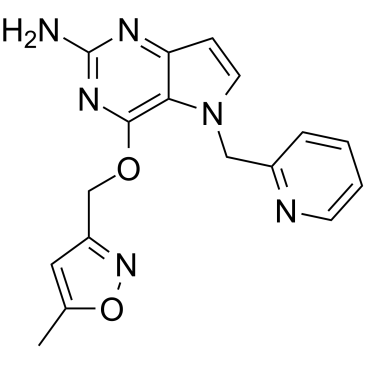
| CAS NO: | 1642857-69-9 |
| 规格: | ≥98% |
| 包装 | 价格(元) |
| 5mg | 电议 |
| 10mg | 电议 |
| 25mg | 电议 |
| 50mg | 电议 |
| 100mg | 电议 |
| Molecular Weight: 336.35 Formula: C17H16N6O2 CAS No.: 1642857-69-9 SMILES: CC1=CC(COC2=C(N(CC3=NC=CC=C3)C=C4)C4=NC(N)=N2)=NO1 | |
| Storage | -20℃ for 3 years in powder form |
| -80℃ for 2 years in solvent | |
| Technical Information | TLR7 agonist 2; TLR7 agonist-2 |
| Target | LEC: 0.4 μM (TLR7)[1] |
|---|---|
| In Vitro | TLR7-agonist-1 is a potent and selective Toll-like Receptor 7 (TLR7) agonist with a lowest effective concentration (LEC) of 0.4 μM in HEK293 cell. TLR7-agonist-1 is found to be selective for TLR7 over TLR8 with LEC of>100 μM for human TLR8. TLR7-agonist-1 demonstrates low inhibition across five CYP450 isozymes (IC50>10 μM) and is also not a time dependent inhibitor of CYP450 3A4. TLR7-agonist-1 has limited inhibition of the hERG potassium ion channel 3H-dofetilide binding in vitro (IC50>50 μM)[1]. |
| In Vivo | TLR7-agonist-1 is found to be rapidly cleared in conjunction with our target profile. Both Cmax and AUC increase less than dose proportionally between 0.3 and 3 mg/kg and more than dose-proportionally between 3 and 10 mg/kg. TLR7-agonist-1 can induce an antiviral interferon stimulated gene (ISG) response without inducing an IFNα response at a low dose. TLR7-agonist-1 also induces a 2.7 log decrease in serum HBV viral load from 0.3 mg/kg, and a maximum 3.1 log decrease is observed for doses between 1 and 5 mg/kg[1]. |
| Cell Assay | The ability of TLR7-agonist-1 to activate human TLR7 and/or TLR8 is assessed by using HEK293 cells. Briefly, HEK293 cells are grown in culture medium (DMEM supplemented with 10% FCS and 2 mM Glutamine). Transfected cells are then detached with Trypsin-EDTA, washed in PBS and resuspended in medium to a density of 1.67×10⁵ cells/mL. Thirty microliters of cells are then dispensed into each well in 384-well plates, where 10 μL of TLR7-agonist-1 in 4% DMSO is already present. Following 6 hours incubation at 37°C, 5% CO2, the luciferase activity is determined by adding 15 μL of Steady Lite Plus substrate to each well and readout performed on a microplate imager. Lowest effective concentrations (LEC) values are determined for TLR7-agonist-1[1]. |
| Animal Admin | A mouse in vivo model is used to demonstrate the initial proof of concept to induce endogenous IFNα. Single oral administration of 0.3, 1, 3, and 10 mg/kg doses of TLR7-agonist-1 is given to healthy, female, fasted C57Bl/6 mice. Concentrations of TLR7-agonist-1 and mouse-IFN via ELISA are measured from the plasma and compare to vehicle[1]. |
| References | [1]. Identification and Optimization of Pyrrolo[3,2-d]pyrimidine Toll-like Receptor 7 (TLR7) Selective Agonists for the Treatment of Hepatitis B. J Med Chem. 2017 Jul 27;60(14):6137-6151 |
 m.cnreagent.com