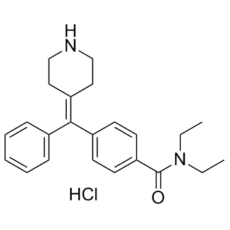
| CAS NO: | 209808-47-9 |
| 规格: | ≥98% |
| 包装 | 价格(元) |
| 5mg | 电议 |
| 10mg | 电议 |
| 25mg | 电议 |
| 50mg | 电议 |
| 100mg | 电议 |
| 250mg | 电议 |
| 500mg | 电议 |
| Molecular Weight (MW) | 384.95 |
|---|---|
| Formula | C23H29ClN2O |
| CAS No. | 209808-47-9 (HCl); |
| Storage | -20℃ for 3 years in powder form |
| -80℃ for 2 years in solvent | |
| Solubility (In vitro) | DMSO: ≥ 150 mg/mL (390 mM) |
| Water: N/A | |
| Ethanol: N/A | |
| Chemical Name | N,N-diethyl-4-(phenyl-piperidin-4-ylidenemethyl)benzamide hydrochloride |
| Synonyms | ARM-390 HCl; AR M1000390; ARM 390; ARM1000390 HCl; ARM390; AR-M1000390; ARM-390 hydrochloride. |
| In Vitro | In vitro activity: AR-M 1000390 (Compound 6a) exhibits the binding affinities (IC50) of 0.87±0.23 nM for the δ opioid receptor and extremely high selectivity over the μ receptor (IC50=3800±172 nM) and the κ receptor (IC50=7470±606 nM). RINm5F cells are treated with AR-M 1000390 (AR-M100390) and Cyclizine for 16-24 h before measurement of intracellular and secreted insulin levels. AR-M 1000390 mediates a dose-dependent decrease in insulin content with a maximal inhibition of ~90% at the highest concentration tested (10 μM). Kinase Assay: AR-M 1000390 hydrochloride (the hydrochloric acid of ARM-390) is a potent, highly selective agonist of δ opioid receptor with an EC50 of 7.2±0.9 nM. |
|---|---|
| In Vivo | Rats are treated with 5, 100, and 600 μmol/kg of AR-M 1000390 (AR-M100390) for 3 and/or 7 days; another group of rats treated with 600 μmol/kg of compound are allowed to recover for 14 days. AR-M 1000390 (600 μmol/kg) causes vacuolation in the β-cell of the rat pancreas that is associated with depletion of insulin and hyperglycemia after 7 days of dosing. Treatment of rats with 600 μmol/kg of AR-M 1000390 results in vacuolation of the β-cell of the rat pancreas that is similar to that reported for cyclizine and cyproheptadine. |
| Animal model | Rats |
| Formulation & Dosage | 5, 100, and 600 μmol/kg |
| References | Toxicol Sci. 2008 Sep;105(1):221-9. |
 m.cnreagent.com