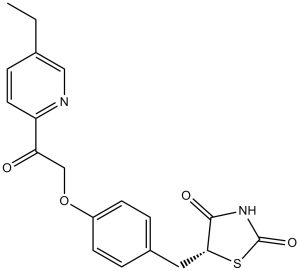
| CAS NO: | 146062-49-9 |
| 规格: | ≥98% |
| 包装 | 价格(元) |
| 1mg | 电议 |
| 2mg | 电议 |
| 5mg | 电议 |
| 10mg | 电议 |
| 25mg | 电议 |
| 50mg | 电议 |
| 100mg | 电议 |
| 250mg | 电议 |
| 500mg | 电议 |
| Molecular Weight (MW) | 370.42 |
|---|---|
| Formula | C19H18N2O4S |
| CAS No. | 146062-49-9 |
| Storage | -20℃ for 3 years in powder form |
| -80℃ for 2 years in solvent | |
| Solubility (In vitro) | DMSO: <1 mg/mL |
| Water: <1 mg/mL | |
| Ethanol: <1 mg/mL | |
| SMILES | O=C(N1)SC(CC2=CC=C(OCC(C3=NC=C(CC)C=C3)=O)C=C2)C1=O |
| Synonyms | Mitoglitazone; CAY10415; MSDC 0160; CAY 10415; MSDC-0160; CAY-10415; CAY 10415; CAY-10415; MSDC0160; CAY10415; |
| In Vitro | In vitro activity: MSDC-0160 reduces resistance in the insulin/IGF-1 signaling pathway and restores IGF-1-induced Akt and GSK-3 phosphorylation. MSDC-0160 in combination with IGF-1 and 8 mM glucose increases β-cell specific gene expression of insulin, pdx1, nkx6.1, and nkx2.2, and maintains insulin content without altering glucose-stimulated insulin secretion. Furthermore, MSDC-0160 promotes human β-cell differentiation and reduces the expression of markers of apoptosis. Kinase Assay: MSDC-0160 at 50μM alone also prevents the loss of insulin content significantly. Besides that, treatment of MSDC-0160 increases the phosphorylation of AMPK and reduces mTOR phosphorylation. Moreover, MSDC-0160 is also found to display pro-survival effects in human islets via reducing the level of cleaved caspase-3 and increasing the expression of apoptosis-related genes such as bcl2. Cell Assay: MSDC-0160 exerts prevention of nuclear translocation with β-catenin localized on the cell membrane or cytoplasm in human β-cells |
|---|---|
| In Vivo | MSDC-0160 (100 mg/kg p.o.) improves insulin sensitivity by resulting in the large decrease in the product of circulating insulin and glucose in diabetic KKAy mice. |
| Animal model | Diabetic KKAy mice |
| Formulation & Dosage | Suspended in 1% sodium methyl carboxycellulose/0.01% Tween 20; 100 mg/kg; p.o. |
| References | PLoS One. 2013 May 1;8(5):e62012; Gene Regul Syst Bio. 2007 Sep 17;1:73-82. |
 m.cnreagent.com