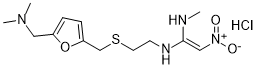
| CAS NO: | 66357-59-3 |
| 规格: | ≥98% |
| 包装 | 价格(元) |
| 250mg | 电议 |
| 500mg | 电议 |
| 1g | 电议 |
| 2g | 电议 |
| 5g | 电议 |
| 10g | 电议 |
| Molecular Weight (MW) | 350.86 |
|---|---|
| Formula | C13H22N4O3S.HCl |
| CAS No. | 66357-59-3 |
| Storage | -20℃ for 3 years in powder form |
| -80℃ for 2 years in solvent | |
| Solubility (In vitro) | DMSO: 70 mg/mL (199.5 mM) |
| Water: 70 mg/mL (199.5 mM) | |
| Ethanol:<1 mg/mL | |
| Solubility (In vivo) | Chemical Name:
(E)-N-(2-(((5-((dimethylamino)methyl)furan-2-yl)methyl)thio)ethyl)-N'-methyl-2-nitroethene-1,1-diamine hydrochloride InChi Key: GGWBHVILAJZWKJ-KJEVSKRMSA-N InChi Code: InChI=1S/C13H22N4O3S.ClH/c1-14-13(9-17(18)19)15-6-7-21-10-12-5-4-11(20-12)8-16(2)3;/h4-5,9,14-15H,6-8,10H2,1-3H3;1H/b13-9+; SMILES Code: CNC(=C[N+](=O)[O-])NCCSCC1=CC=C(O1)CN(C)C.Cl |
| Synonyms | AH19065; Ranitidine Hydrochloride; ZANTAC; AH-19065; AH 19065; Tanidina; Toriol; Fendibina; Gastridina; Sostril; Zantic; Ranisen; Ranitidine HCl |
| In Vitro | In vitro activity: Ranitidine sensitizes hepatocytes to killing by cytotoxic products from activated neutrophils, whereas Famotidine lacks this ability. Ranitidine inhibits the production of tumor necrosis factor-alpha (TNF-alpha) in monocytes stimulated with lipopolysaccharide in vitro. Ranitidine reduces the Kel of morphine dose-dependently with a maximum effect of 50%, and increases the relative concentration of morphine-6-glucuronide to morphine-3-glucuronide in isolated guinea pig hepatocytes. Ranitidine gradually decreases the morphine-3-glucuronide/morphine-6-glucuronide ratio by up to 21%. |
|---|---|
| In Vivo | Ranitidine results in liver injury as evidence by increased in serum alanine aminotransferase, aspartate aminotransferase, and gamma-glutamyl transferase activities within 6 hours after Ranitidine administration in rats. Ranitidine inhibits hepatic ischemia/reperfusion-induced increase in hepatic tissue levels of TNF-alpha, cytokine-induced neutrophil chemoattractant, and hepatic accumulation of neutrophils in rats. Ranitidine cotreatment enhances LPS-induced coagulation prior to liver injury, and anticoagulants reduce liver damage in LPS/RAN-treated rats. Ranitidine /LPS-treated rats results in the formation of fibrin clots in liver sinusoids, and prevention of fibrin deposition associated with reduced hepatocellular injury. Ranitidine cotreatment enhances the LPS-induced TNF increase before the onset of hepatocellular injury in rats. Ranitidine displays anxiolytic effects in the elevated plus-maze as indicated by an increase in time spent in the open arms, more open-arm scanning and more end-excursions in rats. |
| Animal model | Rats |
| Formulation & Dosage | |
| References | J Pharmacol Exp Ther. 2003 Oct;307(1):9-16; J Pharmacol Exp Ther. 2002 Jun;301(3):1157-65. |
 m.cnreagent.com