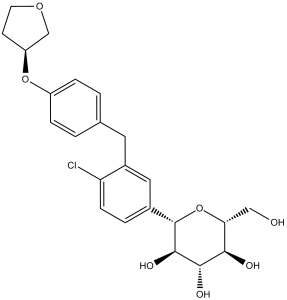
| CAS NO: | 864070-44-0 |
| 规格: | ≥98% |
| 包装 | 价格(元) |
| 25mg | 电议 |
| 50mg | 电议 |
| 100mg | 电议 |
| 250mg | 电议 |
| 500mg | 电议 |
| 1g | 电议 |
| 2g | 电议 |
| 5g | 电议 |
| Molecular Weight (MW) | 450.91 |
|---|---|
| Formula | C23H27ClO7 |
| CAS No. | 864070-44-0 |
| Storage | -20℃ for 3 years in powder form |
| -80℃ for 2 years in solvent | |
| Solubility (In vitro) | DMSO: 90 mg/mL (199.6 mM) |
| Water: <1 mg/mL | |
| Ethanol: <1 mg/mL | |
| Solubility (In vivo) | 15% Captisol: 15 mg/mL |
| Synonyms | BI1-0773; CE0108; CS0940; PB23119; VA10802; AJ93046; BI10773; BI-10773; BI 10773; Empagliflozin; trade name: Jardiance. |
| In Vitro | In vitro activity: Empagliflozin shows>2500-fold selectivity for hSGLT-2 over hSGLT-1 (IC50 8300 nM) and>3500-fold selectivity over hSGLT-4, it exhibits>350-fold selectivity over hSGLT-5 (IC50=1100 nM) and>600-fold selectivity over hSGLT-6. No relevant inhibition of GLUT1 is observed up to 10 μM Empagliflozin. In a kinetic binding experiments, [3H]-empagliflozin displays a high affinity for SGLT-2 with a mean Kd of 57 nM in the absence of glucose, and shows a half-life of [3H]-empagliflozin-binding to SGLT-2 of 59 min in the absence of glucose.Its binding to SGLT-2 is competitive with glucose. Kinase Assay: Stable cell lines over-expressing hSGLT-1, -2, -4, -5 or -6 or rSGLT-1 or -2 are used for the sodium-dependent monosaccharide transport inhibition assay. Cells are pre-incubated in 200 μL uptake buffer (10 mM HEPES, 137 mM NaCl, 5.4 mM KCl, 2.8 mM CaCl2, 1.2 mM MgCl2, 50 μg/ml Gentamycin, 0.1% BSA) for 25 minutes at 37°C. 10 μM Cytochalasin B and test compound is added at different concentrations 15 minutes before the initiation of the uptake experiment. The uptake reaction is started by the addition of 0.6 μCi [14C]-labelled monosaccharide i.e. [14C]-labelled AMG, glucose, fructose, mannose or myo-inositol, in 0.1 mM AMG (or the respective non-radioactive monosaccharide). After incubation for 60 minutes (hSGLT-5), 90 minutes (hSGLT-4) or 4 hours (hSGLT-2) at 37°C, the cells are washed three times with 300 μL PBS and then lysed in 0.1 N NaOH with intermittent shaking for 5 minutes. The lysate is mixed with 200 μL MicroScint 40 and shaken for 15 minutes and counted for radioactivity in the TopCount NXT. For SGLT-4 and SGLT-5 assays cells are pre-incubated in pre-treatment buffer (uptake buffer containing choline chloride instead of NaCl) for 25 minutes prior to addition of uptake buffer. Cell Assay: When tested with a panel of human cell lines over-expressed SGLT-1, 2, 4, 5 and 6, Empagliflozin treatment competitively bind to SGLT-2 over glucose at low dose. In human proximal tublular cell (PTC) cell line HK2 cells, Empagliflozin treatment for 72 h inhibits the expression of SGLT-2 which in turn reversed high glucose induced TLR4 expression, NF-κB binding, IL-6 secretion, AP-1 binding and CIV expression. |
|---|---|
| In Vivo | High exposure of empagliflozin is achieved in dogs, with plasma concentrations>100-fold above IC50 measured 24 h after administration of 5 mg/kg empagliflozin. The total plasma clearance of empagliflozin in ZDF rat is 43 mL/min/kg, while in dogs is lower at 1.8 mL/min/kg. Cmax of empagliflozin in ZDF rat and dogs is 167 nM and 17254 nM, respectively. Terminal elimination half-life in ZDF rat and dogs is 1.5 h and 6.3 h, respectively. Bioavailability of empagliflozin in ZDF rat is 33.2%, while in dogs is higher at 89.0%. Long-term treatment with empagliflozin, improves glycaemic control and features of metabolic syndrome in diabetic rats. |
| Animal model | ZDF rats and beagle dogs |
| Formulation & Dosage | Dissolved in 4.4% HP-β-cyclodextrin in normal saline (intravenously) or 0.5% hydroxyethylcellulose (orally); 2 mg/kg; i.v. administration. |
| References | Diabetes Obes Metab. 2012 Jan;14(1):83-90; Diabetes Obes Metab. 2012 Jan;14(1):94-6. |
 m.cnreagent.com