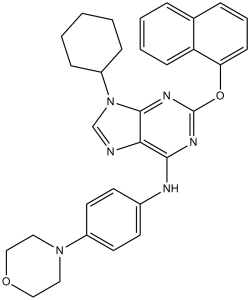
| CAS NO: | 483367-10-8 |
| 规格: | ≥98% |
| 包装 | 价格(元) |
| 2mg | 电议 |
| 5mg | 电议 |
| 10mg | 电议 |
| 25mg | 电议 |
| 50mg | 电议 |
| 100mg | 电议 |
| 250mg | 电议 |
| 500mg | 电议 |
| Molecular Weight (MW) | 520.62 |
|---|---|
| Formula | C31H32N6O2 |
| CAS No. | 483367-10-8 |
| Storage | -20℃ for 3 years in powder form |
| -80℃ for 2 years in solvent | |
| Solubility (In vitro) | DMSO: 4 mg/mL (7.7 mM) |
| Water:<1 mg/mL | |
| Ethanol:<1 mg/mL | |
| Solubility (In vivo) | 2% DMSO+30% PEG 300+5% Tween 80+ddH2O: 1 mg/mL |
| Synonyms | Shh Signaling Antagonist VI |
| In Vitro | In vitro activity: Purmorphamine activates the Hedgehog pathway by directly binds and activates Smoothened with IC50 of ~ 1.5 μM in compete with cyclopamine, a Smo antagonist. Purmorphamine is a potent inducer of osteogenesis in multipotent C3H10T1/2 cells. The EC50 (based on ALP expression) for Purmorphamine is 1 μM in C3H10T1/2 cells. Purmorphamine (1 μM) and BMP-4 (100 ng/mL) together increase ALP activity more than 90-fold in 3T3-L1 cells. In contrast to BMP-4, Purmorphamine induces osteogenesis by activating Hedgehog signaling in multipotent mesenchymal progenitor cells. Kinase Assay: Smo binding assays are conducted with BODIPY-cyclopamine and Smo-overexpressing cells as previously described4,5, using CMV promoter-based, SV40 origin-containing expression constructs for Smo-Myc3, the deletion mutant Smo?CRD (deletion of amino acids 68 to 182), and Smo?CT (deletion of amino acids 556 to 793). HEK 293T cells are grown on poly-D-lysine-treated glass coverslips in 12-well plates until 70% confluency and then transfected with the appropriate expression construct (0.5 ?g/well) using FuGene 6 according the manufacturer's protocols. Two days after transfection, the HEK 293T cells are incubated with DMEM containing 0.5% bovine calf serum, 5 nM BODIPY-cyclopamine, and varying concentrations of Purmorphamine (0, 1.5, or 5 ?M) (1 mL/well) for 1 h at 37 ℃. The Smo-overexpressing cells are then washed with 1 × PBS buffer (1 mL/well), mounted with DAPI-containing medium, and visualized using a Leica DM4500B fluorescence microscope. For binding assays using fixed cells, the Smo-overexpressing HEK 293T cells are fixed with 3% paraformaldehyde in 1 × PBS buffer for 10 min at room temperature (1 mL/well), treated with 1 × PBS containing 10 mM glycine and 0.2% sodium azide for 5 min (1 mL/well), washed with 1 × PBS buffer (1 mL/well), and treated with the Purmorphamine-containing media described above for 4 h at room temperature. Cell Assay: C3H10T1/2 cells are expanded in T175 flasks; cells at 13th passage are detached by trypsin/EDTA and diluted in the growth media. The resulting cell suspension is then plated into black clear bottom 384-well plates with 2500 cells/well in 100 μL growth medium using a Multi-dropTM liquid delivery system. After overnight incubation, cells attached to the bottom of the wells. A stock solution of each Purmorphamine in DMSO (500 nL) is delivered into corresponding well using a Mini TrakTM multiposition dispenser system to make a final concentration of 5μM of Purmorphamine. Cells are then incubated at 37 ℃ with 5% CO2 in air atmosphere. After 4 days, the medium is removed and 10 μL of passive lysis buffer is added into each well. After 5 min, 10 μL of alkaline phosphatase substrate solution is added to each well. After incubating 15 min at room temperature, the plates are read on an Acquest high-throughput plate reader following the manufacturer's protocol. |
|---|---|
| In Vivo | Purmorphamine up-regulates ALP expression in human mesenchymal stem cell-based constructs on rats. |
| Animal model | Normal male Wistar rats |
| Formulation & Dosage | 5 μM; s.c. injection |
| References | Nat Chem Biol. 2006 Jan;2(1):29-30; J Am Chem Soc. 2002 Dec 11;124(49):14520-1. |
 m.cnreagent.com