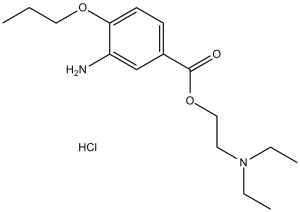
| CAS NO: | 5875-06-9 |
| 规格: | ≥98% |
| 包装 | 价格(元) |
| 50mg | 电议 |
| 100mg | 电议 |
| 250mg | 电议 |
| 500mg | 电议 |
| 1g | 电议 |
| 2g | 电议 |
| Molecular Weight (MW) | 330.85 |
|---|---|
| Formula | C16H26N2O3.HCl |
| CAS No. | 5875-06-9 |
| Storage | -20℃ for 3 years in powder form |
| -80℃ for 2 years in solvent | |
| Solubility (In vitro) | DMSO: 12 mg/mL (36.3 mM) |
| Water: 66 mg/mL (199.5 mM) | |
| Ethanol: <1 mg/mL | |
| Solubility (In vivo) | Saline: 30 mg/mL |
| Synonyms | Proxymetacaine; Proxymetacaine |
| In Vitro | In vitro activity: Proparacaine is more potent and less toxic than cocaine. Proparacaine significantly increases in FHV-1 (P < 0.01), C. felis, and 28S rDNA Ct values when fusidic acid is used. Kinase Assay: Cell Assay: |
|---|---|
| In Vivo | Proparacaine inhibits corneal epithelial migration and adhesion through alteration of the actin cytoskeleton. Proparacaine acts like bupivacaine or lidocaine and produces dose-related spinal blockades of motor function, proprioception and nociception. Intrathecal proxymetacaine also produces longer sensory blockade than motor blockade. |
| Animal model | Male Sprague–Dawley rats |
| Formulation & Dosage | Dissolved in saline; 10 μmol/kg; Intrathecally |
| References | Exp Eye Res. 1994 Apr;58(4):469-78; Neurosci Lett. 2009 May 1;454(3):249-53. |
 m.cnreagent.com