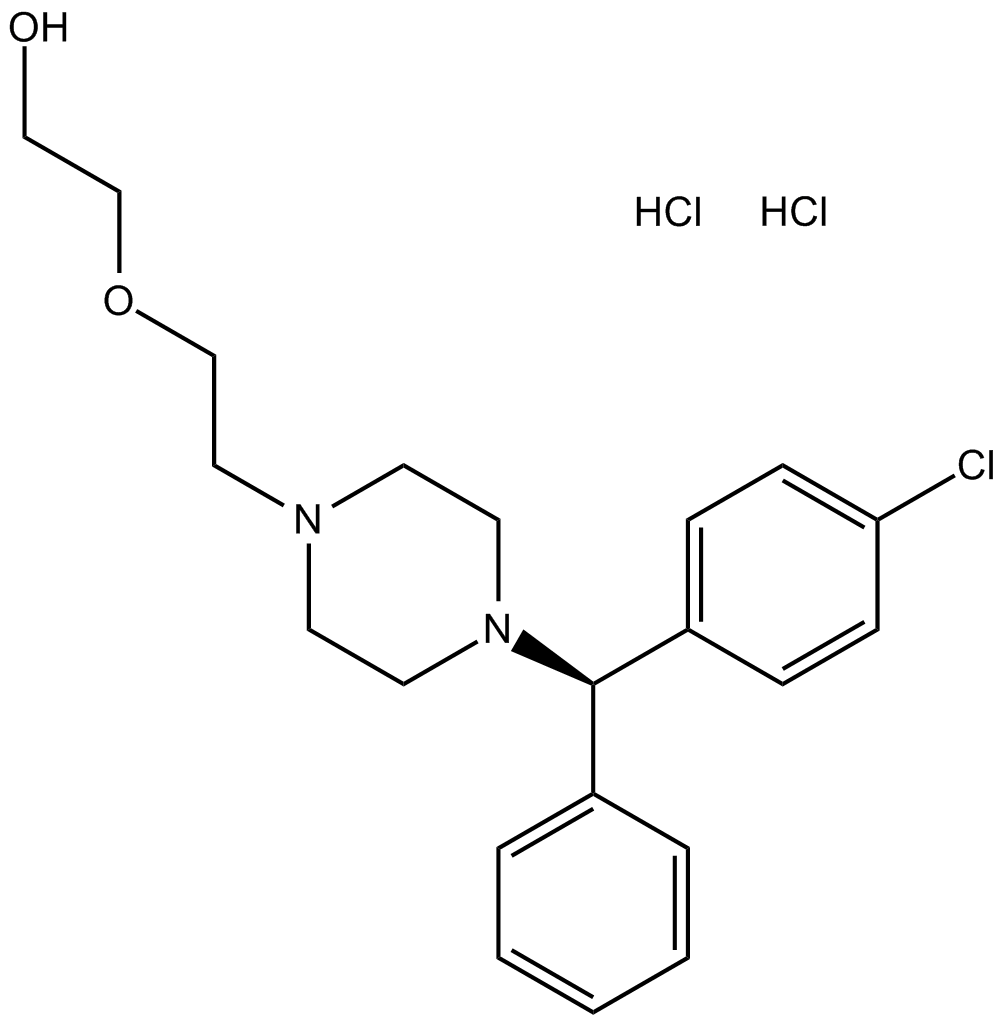
| CAS NO: | 2192-20-3 |
| 包装 | 价格(元) |
| 10mM (in 1mL DMSO) | 电议 |
| 50mg | 电议 |
| Cas No. | 2192-20-3 |
| 别名 | 盐酸羟嗪 |
| 化学名 | 2-[2-[4-[(4-chlorophenyl)-phenylmethyl]piperazin-1-yl]ethoxy]ethanol;dihydrochloride |
| Canonical SMILES | C1CN(CCN1CCOCCO)C(C2=CC=CC=C2)C3=CC=C(C=C3)Cl.Cl.Cl |
| 分子式 | C21H27ClN2O2.2HCl |
| 分子量 | 447.83 |
| 溶解度 | ≥ 21.5mg/mL in DMSO |
| 储存条件 | 4°C, protect from light |
| General tips | For obtaining a higher solubility , please warm the tube at 37 ℃ and shake it in the ultrasonic bath for a while. |
| Shipping Condition | Evaluation sample solution : ship with blue ice All other available size: ship with RT , or blue ice upon request |
| 产品描述 | Hydroxyzine dihydrochloride is a histamine H1-receptor antagonist.Target: Histamine H1-ReceptorHydroxyzine dihydrochloride inhibits carbachol (10 μM)-induced serotonin release by 34% at 10 μM, by 25% 1 μM and by 17% 0.1 μM in pretreated bladder slices for 60 min [1]. Hydroxyzine dihydrochloride (0.1 mM) treatment inhibits the progression and severity of EAE by 50% and the extent of mast cell degranulation by 70% in Lewis rats with allergic encephalomyelitis (EAE) [2]. Hydroxyzine dihydrochloride (500 M) significantly increases transport of etoposide to the serosal site in the jejunal everted sacs. Hydroxyzine dihydrochloride significantly reduces the efflux and approximately 2.4 g/mL of etoposide in the jejunum and ileum. Hydroxyzine (0.2 μg/mL) significantly enhances the efflux of RH123 to the lumen [3].Hydroxyzine dihydrochloride (500 μM) significantly decreases the steady-state etoposide concentration 2-fold, where the steady-state concentration reached about 0.055 μM/mL in Sprague-Dawley rats [3]. Hydroxyzine dihydrochloride (12.5 mg/kg, 25 mg/kg and 50 mg/kg i.p.) shows little direct analgesic activity but markedly potentiates only the effect of morphine on the vocalization after-discharge which represents the affective component of pain in rats.Hydroxyzine dihydrochloride (50 mg/kg i.p.) potentiates morphine on the tail-flick test, while Hydroxyzine (12.5 mg/kg i.p.) decreases morphine antinociception in rats [4]. References: |
 m.cnreagent.com