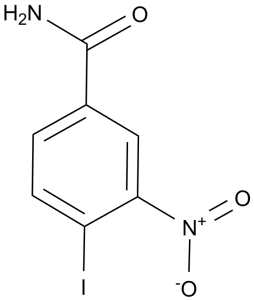
| CAS NO: | 160003-66-7 |
| 规格: | ≥98% |
| 包装 | 价格(元) |
| 5mg | 电议 |
| 25mg | 电议 |
| 50mg | 电议 |
| 100mg | 电议 |
| 250mg | 电议 |
| 500mg | 电议 |
| Molecular Weight (MW) | 292.03 |
|---|---|
| Formula | C7H5IN2O3 |
| CAS No. | 160003-66-7 |
| Storage | -20℃ for 3 years in powder form |
| -80℃ for 2 years in solvent | |
| Solubility (In vitro) | DMSO: 58 mg/mL (198.6 mM) |
| Water: <1 mg/mL | |
| Ethanol: 28 mg/mL (95.9 mM) | |
| Other info | Chemical Name: 4-iodo-3-nitrobenzamide InChi Key: MDOJTZQKHMAPBK-UHFFFAOYSA-N InChi Code: InChI=1S/C7H5IN2O3/c8-5-2-1-4(7(9)11)3-6(5)10(12)13/h1-3H,(H2,9,11) SMILES Code: O=C(N)C1=CC=C(I)C([N+]([O-])=O)=C1 |
| Synonyms | NSC-746045, IND-71677; BSI-201; BSI201; BSI 201; NSC746045; NSC-746045; NSC 746045; ND-71677; NIBA; INO-2BA; SAR-240550; SAR 240550; SAR240550; IND-71677; IND 71677; IND71677; Iniparib; |
| In Vitro | In vitro activity: BSI-201 is described as a prodrug of 4-iodo-3-nitrosobenzamide, an agent that covalently inhibits PARP1 by binding to its first zinc finger under cell-free conditions. Treatment of 120 μM BSI-201 plus buthionine sulfoximine (BSO) induces a 95% cell death among 855-2 cells, and displays a similar effect in other human cancer cells. BSI-201 inhibits the growth of E-ras 20 cells, the effect of which can be augmented 4-fold when BOS is added. Recently BSI-201 shows no ability to inhibit PARP enzymatic or cellular activity, but can non-selectively modify cysteine-containing proteins in tumor cells, suggesting the mechanism of action for BSI-201 is likely not via inhibition of PARP activity. BSI-201 (100 μM) inhibits ionizing radiation-induced single-strand breaks (SSBs) repair in human lymphoid cell lines based on large endogenous Epstein–Barr virus (EBV) circular episomes assay, resulting in 55% repair by 2 hours, which can be reversed surprisingly by knockdown of PARP1, indicating that the mechanism of inhibition does not involve trapping PARP at SSBs. BSI-201 is not able to selectively kill homologous recombination (HR)-deficient cells between BRCA2-deficient PEO1 and BRCA2-revertant PEO4, or ATM-deficient GM16666 and ATM-restored GM16667 fibroblasts. BSI-201 is cytotoxic to a variety of cell lines at concentrations above 40 μM reflecting a mechanism independent of PARP Cell Assay: Cells are exposed to various concentrations of BSI-201 for 5, and 9 days in the presence or absence of buthionine sulfoxamide (BSO). After treatment, cell proliferation is measured by CellTiter-Glo assay |
|---|---|
| In Vivo | N/A |
| Animal model | N/A |
| Formulation & Dosage | N/A |
| References | Biochem Pharmacol. 1995 Aug 25;50(5):705-14; Biochem Pharmacol. 2002 Feb 1;63(3):455-62; Clin Cancer Res. 2012 Jan 15;18(2):510-23. |
 m.cnreagent.com