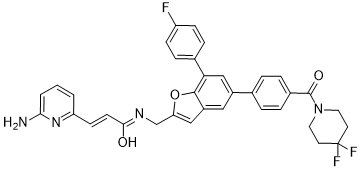
| CAS NO: | 1643913-93-2 |
| 规格: | ≥98% |
| 包装 | 价格(元) |
| 5mg | 电议 |
| 10mg | 电议 |
| 25mg | 电议 |
| 50mg | 电议 |
| 100mg | 电议 |
| 250mg | 电议 |
| Molecular Weight (MW) | 610.63 |
|---|---|
| Formula | C35H29F3N4O3 |
| CAS No. | 1643913-93-2 |
| Storage | -20℃ for 3 years in powder form |
| -80℃ for 2 years in solvent | |
| Solubility (In vitro) | DMSO: 100 mg/mL (163.8 mM) |
| Water: < 1 mg/mL | |
| Ethanol: 100 mg/mL (163.8 mM) | |
| Chemical Name | (1Z,2E)-3-(6-aminopyridin-2-yl)-N-((5-(4-(4,4-difluoropiperidine-1-carbonyl)phenyl)-7-(4-fluorophenyl) benzofuran-2-yl)methyl)acrylimidic acid |
| Synonyms | KPT9274; PAK4-IN-1; KPT-9274; PAK4-IN 1; KPT 9274; PAK4-IN1 |
| SMILES Code | OC(/C=C/C1=NC(N)=CC=C1)=N\CC2=CC3=CC(C4=CC=C(C(N5CCC(F)(F)CC5)=O)C=C4)=CC(C6=CC=C (F)C=C6)=C3O2 |
| In Vitro | In vitro activity: KPT-9274 interferes with PAK4 and NAD biosynthetic pathways resulting in reduction of G2/M transit as well as induction of apoptosis and decrease in cell invasion and migration in several human RCC cell lines. The inhibition of the PAK4 pathway by KPT-9274 attenuates nuclear β-catenin as well as the Wnt/β-catenin targets cyclin D1 and c-Myc Kinase Assay: KPT-9274 is a non-competitive dual inhibitor of PAK4 and NAMP with an IC50 of ~120 nM for NAMPT in a cell-free enzymatic assay. Cell Assay: cell migration and invasion assays were performed using transwell chambers. For the transwell migration assay, 1.5×10⁴ cells were seeded on top of the polycarbonate filters, and 0.6 ml of growth medium with DMSO or KPT-9274 (1μM and 5μM) was added to both the upper and lower wells. After incubation for 12 hours, the filters were swabbed with a cotton swab, fixed with methanol, and then stained with Giemsa solution. For the in vitro invasion assay, filters were coated with Matrigel, and 2.5×10⁴ cells were seeded onto the Matrigel and incubated for 20 hours. The cells attached to the lower surface of the filter were counted under a light microscope (10× magnification). |
|---|---|
| In Vivo | KPT-9274 treatment of the 786-O (VHL-mut) human RCC xenograft model leads to dose-dependent inhibition of tumor growth with no apparent toxicity. It also shows remarkable anti-tumor activity in sub-cutaneous xenograft models of pancreatic ductal adenocarcinoma (PDAC) cell lines and cancer stem cells as a single agent. KPT-9274 possesses desirable PK properties and is well tolerated in mice with the absence of any signs of toxicity when 200 mg/kg daily is administered either intravenously or orally. |
| Animal model | 786-O (VHL-mut) human RCC xenograft mice model |
| Formulation & Dosage | Formulated in 58% Polyvinylpyrrolidone K30 + 21% methyl cellulose + 21% Phospholipon 90G; 100 and 200 mg/kg; P.O. |
| References | Mol Cancer Ther. 2016 Sep;15(9):2119-29. |
 m.cnreagent.com