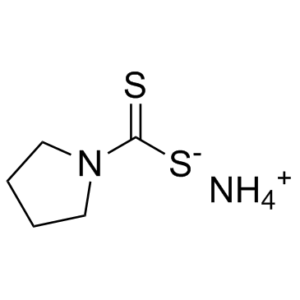
| CAS NO: | 5108-96-3 |
| 规格: | ≥98% |
| 包装 | 价格(元) |
| 100mg | 电议 |
| 250mg | 电议 |
| 500mg | 电议 |
| 2g | 电议 |
| 5g | 电议 |
| 10g | 电议 |
| Molecular Weight (MW) | 164.29 |
|---|---|
| Formula | C5H9NS2.H3N |
| CAS No. | 5108-96-3 |
| Storage | -20℃ for 3 years in powder form |
| -80℃ for 2 years in solvent | |
| Solubility (In vitro) | DMSO:>35 mg/mL |
| Water: >35 mg/mL | |
| Ethanol: >35 mg/mL | |
| Solubility (In vivo) | |
| Synonyms | Pyrrolidinedithiocarbamate ammonium; Ammonium 1-Pyrrolidinecarbodithioate; PDTC; APDC. |
| SMILES Code | [S-]C(N1CCCC1)=S.[NH4+] |
| In Vitro | In vitro activity: Pretreatment of cells with pyrrolidinedithiocarbamate (3-1000 μM) dose-dependently attenuates IL-8 production. Furthermore, pyrrolidinedithiocarbamate (100 μM) suppresses the accumulation of IL-8 mRNA. Pyrrolidinedithiocarbamate inhibits the activation of NF-kB, because pyrrolidinedithiocarbamate suppresses both NF-kB DNA binding and NF-kB-dependent transcriptional activity. NF-kB inhibition with pyrrolidinedithiocarbamate decrease IL-8 production by intestinal epithelial cells. Kinase Assay: Cell Assay: The human colon cancer cell line HT-29 is obtained and cells are grown in modified McCoy’s 5A medium supplemented with 10% fetal bovine serum. To study the effect of pyrrolidinedithiocarbamate ammonium on IL-8 production, HT-29 cells in 96-well plates are induced with 20 ng/mL of IL-1β for 18 h. Various concentrations (3-1000 μM) of pyrrolidinedithiocarbamate or its vehicle (culture medium) are added to the cells 30 min prior to IL-1β stimulation. The concentration of IL-8 in the supernatant is determined using solid-phase enzyme-linked immunosorbent assay. |
|---|---|
| In Vivo | The DSS+pyrrolidinedithiocarbamate ammonium-treated groupII exhibits suppression of shortening of intestinal length and reduction of DAI score. Activated NF-κB level and IL-1β and TNF-α levels are significantly lower in DSS+pyrrolidinedithiocarbamate ammonium-treated groupII. These findings suggest that suppression of NF-κB activity by pyrrolidinedithiocarbamate ammonium can delay the healing of mucosal tissue defects (erosions or ulcers) arising from inflammation, but that it can strongly suppress the expression of inf-lammatory cytokines (IL-1β and TNF-α), resulting in significant alleviation of colitis. pyrrolidinedithiocarbamate ammonium is useful for the treatment of ulcerative colitis |
| Animal model | Sprague-Dawley rats |
| Formulation & Dosage | Dissolved in saline; 50, 100, and 200 mg/kg; i.v. |
| References | Pharm Biol. 2014 Nov;52(11):1460-6. |
 m.cnreagent.com