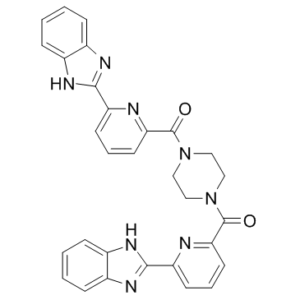
| CAS NO: | 1912399-75-7 |
| 规格: | ≥98% |
| 包装 | 价格(元) |
| 5mg | 电议 |
| 10mg | 电议 |
| 25mg | 电议 |
| 50mg | 电议 |
| 100mg | 电议 |
| 250mg | 电议 |
| Molecular Weight (MW) | 528.2 |
|---|---|
| Formula | C30H24N8O2 |
| CAS No. | 1912399-75-7 (free base); |
| Storage | -20℃ for 3 years in powder form |
| -80℃ for 2 years in solvent | |
| Solubility (In vitro) | DMSO: ≥ 30 mg/mL |
| Water: <1 mg/mL | |
| Ethanol: <1 mg/mL | |
| Solubility (In vivo) | O=C(N1CCN(C(C2=NC(C3=NC4=CC=CC=C4N3)=CC=C2)=O)CC1)C5=NC(C6=NC7=CC=CC=C7N6)=CC=C5 |
| Synonyms | BT-11; BT 11; BT11 |
| In Vitro | In vitro activity: BT-11 is a first-in-class, potent, orally available and selective modulator of LANCL2 (Lanthionine synthetase C-like 2) which is a novel therapeutic target for inflammatory and autoimmune diseases and diabetes, exerts anti-inflammatory and insulin-sensitizing effects. BT-11 at high doses has an excellent safety profile up to 1000 mg/kg/day. It has demonstrated therapeutic efficacy in 3 validated mouse models of colitis at doses as low as 8 mg/kg/d; It protects from IBD by targeting LANCL2. BT-11 has potential to be a safe and effective orally active therapeutic for IBD. The oral treatment with BT-11 (8 mg/kg/d) in a mouse model of IBD resulted in lowering the disease activity index, decreasing colonic inflammatory lesions by 4-fold, and suppressing inflammatory markers (e.g., TNF-α, and interferon-γ) in the gut. Furthermore, studies in LANCL2-/- mice demonstrated that loss of LANCL2 abrogated beneficial actions of BT-11, suggesting high selectivity for the target. In conclusion, BT-11 merits continued development as a LANCL2-based, first-in-class orally active therapeutic for IBD. Kinase Assay: LANCL2 engagement produces an increase of PKA, followed by an accumulation of cAMP in the cytoplasm. BT-11 treatment splenocytes shows a dose–response increase of cAMP production. BT-11 stimulates cAMP production by activating the LANCL2 pathway. |
|---|---|
| In Vivo | Oral treatment with BT-11 at 8 mg/kg/d in a mouse model of inflammatory bowel disease results in lowering the disease activity index, decreasing colonic inflammatory lesions by 4-fold, and suppressing inflammatory markers (e.g., TNF-α, and interferon-γ) in the gut. Furthermore, studies in LANCL2–/– mice demonstrates that loss of LANCL2 abrogates beneficial actions of BT-11, suggesting high selectivity for the target. Oral treatment with BT-11 (8 mg/kg/day) ameliorates colitis in mice. Initial safety assessment in rats indicates that oral treatment with BT-11 at high doses has an excellent safety profile up to 1000 mg/kg/day[1]. BT-11 is well tolerated in rats, and may hold promise as an orally active therapeutic for Crohn’s disease. One hour after oral administration of a single dose of 80 mg/kg, BT-11 has a maximal concentration of 21 ng/mL; the half-life is 3 hours |
| Animal model | Male Harlan Sprague Dawley rats and Wild type and LANCL2–/– male mice with IBD models |
| Formulation & Dosage | 8 mg/kg/d for mouse model; 500 mg/kg and 80 mg/kg/d for rats; oral |
| References | Int J Toxicol. 2016 Sep;35(5):521-9; J Med Chem. 2016 Nov 23;59(22):10113-10126. |
 m.cnreagent.com