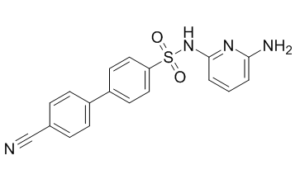
| CAS NO: | 857290-04-1 |
| 规格: | ≥98% |
| 包装 | 价格(元) |
| 5mg | 电议 |
| 10mg | 电议 |
| 25mg | 电议 |
| 50mg | 电议 |
| 100mg | 电议 |
| 250mg | 电议 |
| 500mg | 电议 |
| Molecular Weight (MW) | 350.39 |
|---|---|
| Formula | C18H14N4O2S |
| CAS No. | 857290-04-1 |
| Storage | -20℃ for 3 years in powder form |
| -80℃ for 2 years in solvent | |
| Solubility (In vitro) | DMSO: ≥ 31 mg/mL |
| Water: <1 mg/mL | |
| Ethanol: <1 mg/mL | |
| SMILES | O=S(C1=CC=C(C2=CC=C(C#N)C=C2)C=C1)(NC3=NC(N)=CC=C3)=O |
| Synonyms | PF915275; PF 915275; PF-915275 |
| In Vitro | In vitro activity: PF-915275 is a novel and selective inhibitor of human 11β-hydroxysteroid dehydrogenase type 1 (11betaHSD1) with Ki of<1 nM and good pharmacokinetics. 11betaHSD1 play a key role in ligand-induced activation of the GR through the production of cortisol. Evidence from genetically modified mice suggests that inhibition of 11betaHSD1 might be a therapeutic approach to treat the metabolic syndrome. PF-915275 maintains potency in our cellular assay against human 11βHSD1 (HEK293, EC50 = 5 nM) and is selective against human 11βHSD2 (HEK293, 1.5% inhibition 10 μM). PF-915275 displays only weak affinity for the rodent choline transporter (Ki = 9.6 μM) and the hamster melatonin MT3 receptor (Ki = 9.6 μM) in the Cerep Bioprint screening panel. PF-915275 has good in vitro pharmacokinetic properties. Kinase Assay: PF-915275 maintains potency in our cellular assay against human 11βHSD1 (HEK293, EC50 = 5 nM) and is selective against human 11βHSD2 (HEK293, 1.5% inhibition 10 μM). PF-915275 displays only weak affinity for the rodent choline transporter (Ki = 9.6 μM) and the hamster melatonin MT3 receptor (Ki = 9.6 μM) in the Cerep Bioprint screening panel. |
|---|---|
| In Vivo | Adult cynomolgus monkeys were administered either vehicle or various doses of PF-915275 followed by a 10-mg/kg dose of prednisone. Prednisone conversion to prednisolone and the concentrations of PF-915275 were measured by liquid chromatography/tandem mass spectrometry. PF-915275 dose-dependently inhibited 11betaHSD1-mediated conversion of prednisone to prednisolone, with a maximum of 87% inhibition at a 3-mg/kg dose. An exposure-response relationship was demonstrated, with an estimated EC(50) of 391 nM (total) and 17 nM (free). Insulin levels were also reduced in a dose-related manner. These results should enable the development of a biomarker for evaluating target modulation in humans that will aid in identifying 11betaHSD1 inhibitors to treat diabetes and other related metabolic diseases. |
| Animal model | Adult cynomolgus monkey |
| Formulation & Dosage | 10-mg/kg |
| References | J Pharmacol Exp Ther. 2008 Jan;324(1):299-305. |
 m.cnreagent.com