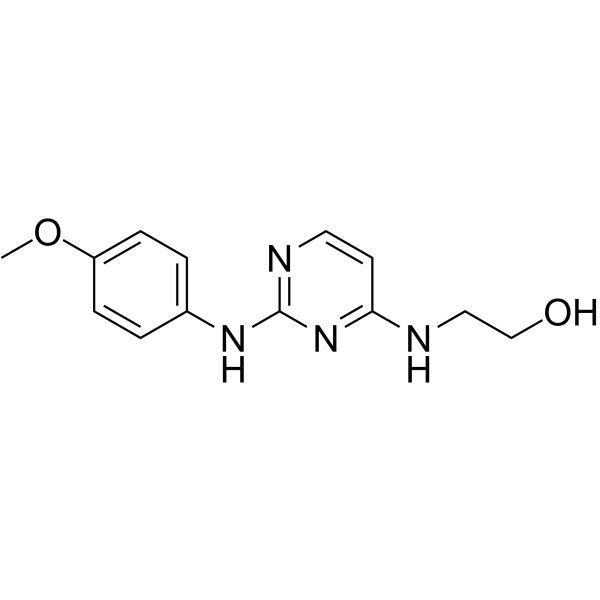
| CAS NO: | 671225-39-1 |
| 包装 | 价格(元) |
| 100mg | 电议 |
| 250mg | 电议 |
| 500mg | 电议 |
| 生物活性 | Cardiogenol C is a potent cell-permeable pyrimidine inducer which prompts thedifferentiation of ESCs into cardiomyocytes(EC50=100 nM)[1]. Cardiogenol C also acts cardiomyogenic on already lineage-committed progenitor cell types with a limited degree of plasticity. Cardiogenol C is a usefulcardiomyogenic agentand can be used as a tool to improve cardiac repair by cell transplantation therapy in animal models[2]. | ||||||||||||||||||||||||
| IC50& Target | EC50: 100 nM (differentiation of ESCs into cardiomyocytes)[1] | ||||||||||||||||||||||||
| 体外研究 (In Vitro) | Cardiogenol C (1 μM; 7 days) has a cardiomyogenic effect on P19 cells, it significantly increases atrial natriuretic factor (ANF, nppa) in P19 cells when it compares to untreated control cells[1].Cardiogenol C (0.01-100 μM; 7 days) significantly increases ANF expression. In addition, another frequently used cardiac marker gene (NKX2-5) is also significantly increased by this small molecule in C2C12 cells[2].Cardiogenol C (0.001-100 μM; 7 days) increases cardiac Nav1.5 sodium channel protein expression as dose-dependent manner in C2C12 cells[2].Cardiogenol C (0.01-100 μM; 7 days) does not effect cell growth even at 10 μM. In addition, Cardiogenol C either solves in water or DMSO generates a similar effect. The highest concentration, 100 μM has significant cellular toxicity on C2C12 cells[2]. RT-PCR[2]
Western Blot Analysis[2]
Cell Proliferation Assay[2]
| ||||||||||||||||||||||||
| 分子量 | 260.29 | ||||||||||||||||||||||||
| Formula | C13H16N4O2 | ||||||||||||||||||||||||
| CAS 号 | 671225-39-1 | ||||||||||||||||||||||||
| 运输条件 | Room temperature in continental US; may vary elsewhere. | ||||||||||||||||||||||||
| 储存方式 | Please store the product under the recommended conditions in the Certificate of Analysis. |
 m.cnreagent.com